
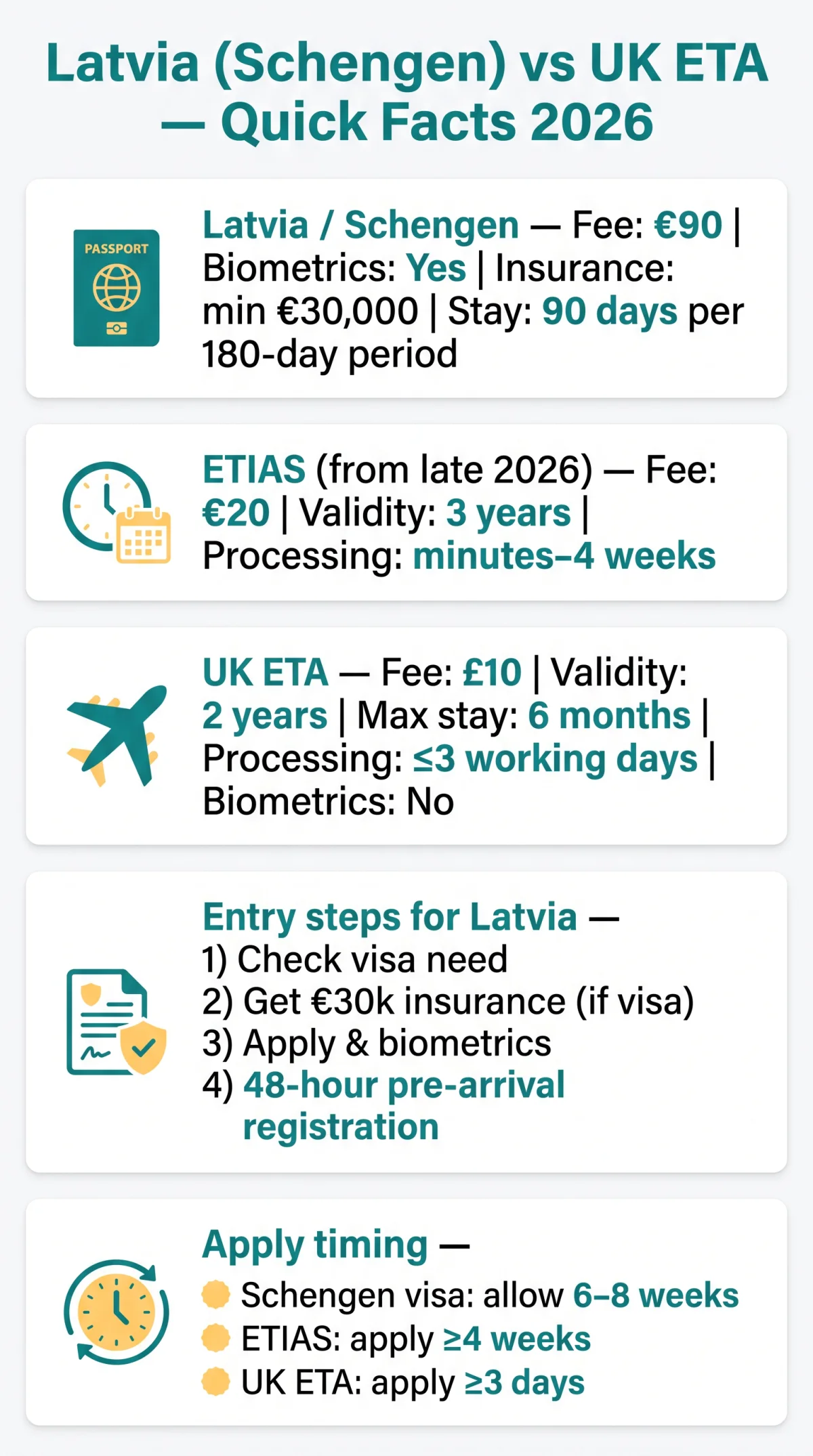
Latvia has no standalone eVisa; entry relies on the Schengen visa framework (€90) or the forthcoming ETIAS (€20, late 2026). By contrast, the UK ETA costs £10, grants 2-year validity, and allows 6-month stays. Schengen requires mandatory travel insurance (€30,000 minimum) and biometrics; the UK ETA requires neither.
The Latvia eVisa vs UK ETA comparison reveals stark differences in cost, processing, and requirements. Schengen visas require biometric data and mandatory travel insurance with a minimum of €30,000 coverage, while the UK ETA requires neither.
Does Latvia Actually Have an eVisa System?
Latvia does not issue a standalone eVisa; short-stay entry falls under the Schengen visa framework, with ETIAS expected in late 2026. As a Schengen member state, Latvia’s short-stay entry is governed by the unified Schengen visa framework rather than a national digital visa scheme. Non-EU travellers who require a visa must apply for a Schengen visa (Type C), which costs €90 for adults and permits stays of 90 days within any rolling 180-day period across all 27 Schengen states.
Three pathways exist for entering Latvia:
- Schengen visa (Type C): €90, 15-45 calendar days processing, biometrics required
- National long-stay visa (Type D): for stays exceeding 90 days
- ETIAS: €20, expected late 2026, visa-waiver pre-screening for visa-exempt travellers
ETIAS will screen applicants against ECRIS, the ETIAS watchlist, SIS, VIS, and EURODAC databases. Fee exemptions apply to travellers under 18 and over 70 years of age. ETIAS authorisations can be revoked for fraudulent submissions or changed applicant circumstances, with appeals filed to the EU Member State that objected. Travellers comparing Latvia eVisa vs UK ETA often start from the misconception that Latvia issues its own eVisa, when the Schengen framework and future ETIAS govern all short-stay entry to Latvian territory.
Latvia also introduced a 48-hour pre-arrival registration requirement effective 1 September 2025, applicable to certain categories of travellers.
UK Electronic Travel Authorisation (ETA): Key Details for 2026
The UK ETA costs £10 per application, is valid for 2 years from approval or until passport expiry (whichever comes first), permits stays of up to 6 months per visit, and typically processes within 3 working days. Travellers can apply through the UK government portal at gov.uk/check-uk-visa.
- Fee: £10 per application, paid by credit or debit card only
- Validity: 2 years from approval or until passport expiry, whichever comes first
- Maximum stay: 6 months per visit; multiple entries permitted during validity
- Processing time: typically within 3 working days; apply at least 3 days before travel
- Eligibility: nationals of approximately 50 countries, including all EU/EEA states post-Brexit
- Biometrics: not required; only a passport photo upload is needed
- Exemptions: Irish citizens; holders of a valid UK visa; those with settled or pre-settled status
- Permitted purposes: tourism, business visits, transit; work, study, and long-term stays are prohibited
- Carrier verification: airlines verify the ETA before boarding
- Cancellation authority: the Home Office can cancel a UK ETA; administrative review is possible for refused applications
Do Latvian Citizens Need a UK ETA?
Yes. Latvian citizens must obtain a UK ETA before travelling to the United Kingdom. The post-Brexit rollout ended visa-free entry for EU/EEA nationals, meaning all Latvian passport holders now require the £10 authorisation, valid for 2 years. Eligibility can be confirmed through the gov.uk visa checker.
Latvia Entry Rules: Schengen 90/180-Day Rule vs UK 6-Month Stay
Schengen allows 90 days in any rolling 180-day period across all 27 states including Latvia. The UK ETA permits stays of up to 6 months per visit for standard visitors. A 5-month (150-day) UK trip is legal under the ETA; a 5-month Schengen trip would exceed the 90/180-day limit by 60 days, requiring a national long-stay visa (Type D).
The 90 days are calculated cumulatively across all 27 Schengen states, not per individual country. ETIAS (when launched in late 2026) will not change the 90/180 rule; it adds a pre-travel screening layer for currently visa-exempt nationals. Latvia’s 48-hour pre-arrival registration (effective 1 September 2025) applies as a transitional requirement alongside the Schengen framework.
Latvia eVisa vs UK ETA: Complete Comparison Table
The Latvia/Schengen pathway costs €90 with mandatory biometrics and insurance, while the UK ETA costs £10 with neither required.
| Attribute | Latvia / Schengen Pathway | UK ETA |
|---|---|---|
| System type | Schengen visa (Type C) or future ETIAS | Electronic Travel Authorisation |
| Fee | €90 (Schengen visa); €20 (ETIAS from late 2026) | £10 |
| Processing time | 15 calendar days (up to 45); ETIAS: minutes to 4 weeks | Typically ≤3 working days |
| Validity | Per application (up to 5 years); ETIAS: 3 years | 2 years or passport expiry |
| Maximum stay | 90 days within 180-day rolling period | 6 months per visit |
| Multiple entries | Yes (with multi-entry visa) | Yes (by default) |
| Biometrics required | Yes (fingerprints + photo) | No (passport photo upload only) |
| Travel insurance mandatory | Yes (min. €30,000 coverage) | No |
| Permitted purposes | Tourism, business, transit | Tourism, business, transit |
| Carrier verification | Airlines verify before boarding | Airlines verify before boarding |
UK ETA is faster and cheaper; the Schengen pathway requires embassy documentation, biometrics, and insurance.
Travel Insurance Requirements Compared
Schengen visa applicants must hold mandatory coverage (min. €30,000); UK ETA applicants do not. This creates a €20-€80 per-trip cost divergence.
Under Schengen Article 15 (Regulation (EU) 2016/399), travellers entering Latvia through the Schengen visa pathway must obtain medical and travel insurance with minimum coverage of €30,000, valid across all Schengen Area countries. The policy must cover repatriation, emergency medical treatment, and hospital care, with estimated costs of €20-€80 per trip depending on duration and traveller age. The insurance certificate must include the applicant’s full name matching their passport, date of birth, repatriation clause, all-Schengen territorial scope, emergency contact information, and policy dates. A missing certificate results in visa refusal. The UK ETA imposes no insurance mandate, though coverage remains recommended.
Global Electronic Travel Authorisation Systems at a Glance
Four systems shape cross-border travel in 2026: UK ETA (£10/2yr/6mo), US ESTA ($21/2yr/90d), ETIAS (€20/3yr/90-day rule), and Schengen visa (€90/5yr/90-day rule).
| Feature | UK ETA | US ESTA | ETIAS (EU/Schengen) | Schengen Visa (Type C) |
|---|---|---|---|---|
| Fee | £10 | $21 | €20 | €90 |
| Validity | 2 years | 2 years | 3 years | Per application (up to 5 years) |
| Max stay | 6 months per visit | 90 days per visit | 90 days / 180-day rolling | 90 days / 180-day rolling |
| Processing | ≤3 working days | ≤72 hours | Minutes to 4 weeks | 15-45 calendar days |
| Biometrics required | No | No | No | Yes (fingerprints + photo) |
| Insurance required | No | No | No | Yes (min. €30,000) |
US ESTA as a Benchmark: How Does It Compare?
US ESTA: $21, 2-year validity, 90-day stay, no insurance or biometrics, US entry only. The UK ETA and US ESTA share identical 2-year validity windows, yet the UK system permits substantially longer continuous stays (6 months vs 90 days). ETIAS, when it launches in late 2026, will introduce a visa-waiver pre-screening layer for the Schengen Area, structurally mirroring the UK ETA but at double the cost (€20 vs £10).
How Long Does Each Authorisation Take? Processing Times Compared
UK ETA: typically ≤3 working days. US ESTA: typically ≤72 hours. ETIAS: minutes for 95% of applications; up to 96 hours for additional checks; up to 4 weeks for additional documentation. Schengen visa: 15 calendar days standard, extendable to 45 days for additional checks. Apply for the UK ETA at least 3 days before travel; for Schengen visas, allow 6-8 weeks. ETIAS applicants should apply at least 4 weeks before departure to account for extended processing edge cases.
Step-by-Step: Applying for Latvia Entry from the UK in 2026
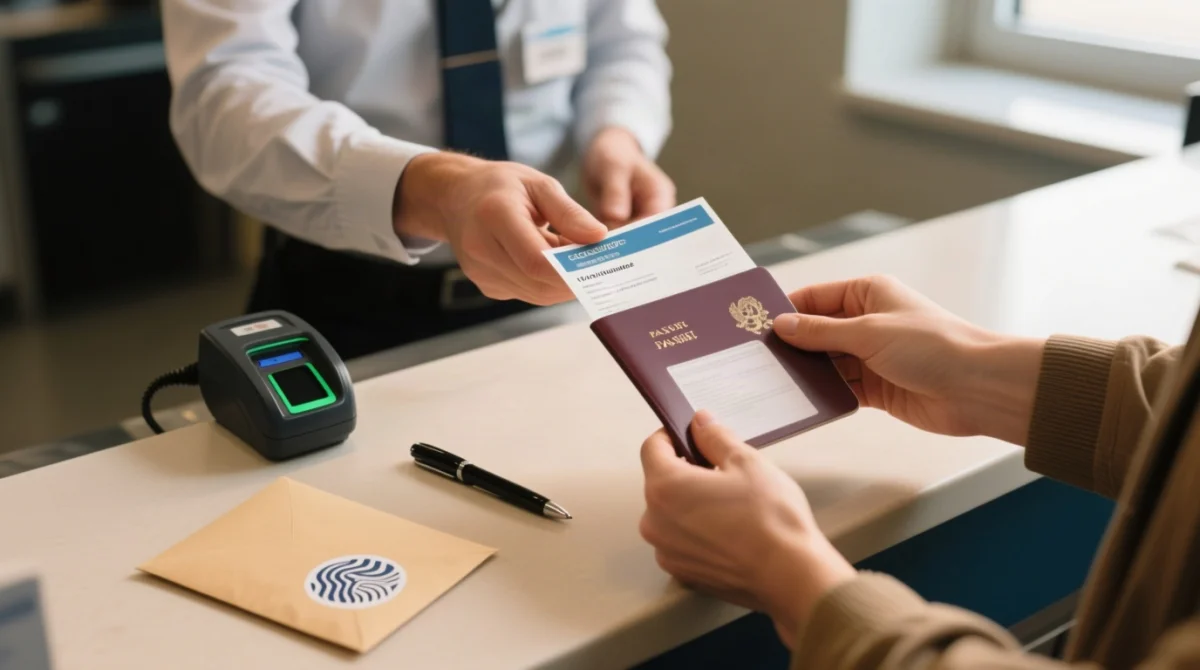
Travellers entering Latvia must determine visa requirements, secure Schengen insurance with a minimum of €30,000 coverage, complete a 48-hour pre-arrival registration (effective since 1 September 2025), and undergo border checks.
Determine your pathway.
Visa-required nationals (e.g., Indian, Chinese) need a Schengen visa (Type C, €90, 15-45 days processing); visa-exempt nationals (e.g., UK, US) currently enter visa-free under the 90/180-day rule until ETIAS (€20, 3-year validity) launches in late 2026.
Check eligibility.
Use the eligibility tools at mfa.gov.lv to confirm whether your nationality requires a Schengen visa for Latvia.
Obtain travel insurance.
Schengen visa applicants must hold medical/travel insurance with minimum €30,000 coverage, valid across all Schengen states, covering repatriation and emergency hospital care. The certificate must show your full name matching your passport, birth date, and policy dates.
Apply for the Schengen visa if required.
Submit through a Latvian consulate or VFS Global; attend a biometrics appointment (fingerprints and photograph); standard processing takes 15 calendar days, extendable to 45 days for additional checks.
Complete the 48-hour pre-arrival registration.
Register with Latvian authorities at least 48 hours before arrival, as mandated since 1 September 2025.
Pass border checks.
Present your passport, insurance certificate (for visa holders), and registration confirmation; expect questions on your purpose of stay.
Why Latvia and the UK Have Separate Systems: Post-Brexit Context
Pre-Brexit (until 31 December 2020): the UK was an EU member but never joined Schengen; free movement applied under EU treaties, not the Schengen Borders Code. Post-Brexit (from 1 January 2021): free movement ended; all EU/EEA nationals including Latvian passport holders now require a UK ETA (£10, 2-year validity) for entry.
Latvia remains a Schengen member state with 22 years of EU membership as of 2026, and its short-stay entry rules continue to be governed by the Schengen Borders Code rather than any national scheme. ETIAS (expected late 2026) will add a parallel electronic authorisation layer for the Schengen zone, creating structural convergence with the UK ETA and potentially simplifying future Latvia eVisa vs UK ETA comparisons.
Last updated: 10 September 2026. All fee and validity data verified against gov.uk and mfa.gov.lv on the date above.
FAQ: Latvia Entry and Schengen Rules
Does Latvia have an eVisa system for UK travellers?
No. Latvia does not issue a standalone eVisa. Short-stay travel falls under the Schengen visa framework. UK passport holders currently enter Latvia visa-free for up to 90 days under the 90/180-day rule.
What is the difference between an eVisa and an ETA?
An eVisa is a digitally issued visa replacing traditional sticker visas. An ETA (Electronic Travel Authorisation) is a lighter pre-travel screening tool, not a visa. The UK uses an ETA; the EU will use ETIAS for visa-exempt visitors from late 2026.
Can I travel to Latvia with a UK BRP?
A UK BRP (Biometric Residence Permit) does not grant entry to Latvia or the Schengen area. BRP holders who are nationals of visa-required countries must apply for a Schengen visa to enter Latvia. Your UK residence status does not replace Schengen entry requirements for your nationality.
Is travel insurance mandatory for visiting Latvia from the UK?
Yes, for Schengen visa applicants. You need medical insurance with a minimum of €30,000 coverage valid across all Schengen states, covering repatriation and emergency hospital care. Visa-free UK passport holders are not legally required to have it, but it is strongly recommended.
How long can I stay in Latvia on a visa-free entry from the UK?
Up to 90 days within any rolling 180-day period across the entire Schengen area. The 90 days are calculated cumulatively across all 27 Schengen states, not per individual country. Track your days carefully to avoid overstaying.
FAQ: UK ETA and System Comparisons
Do Latvian citizens need a UK ETA in 2026?
Yes. Since the UK ETA rollout, all EU/EEA nationals including Latvian citizens must obtain an ETA before travelling to the UK. The fee is £10 per application, valid for 2 years or until passport expiry, allowing multiple entries.
Are UKVI and eVisa the same thing?
No. UKVI (UK Visas and Immigration) is the government department managing immigration. The eVisa is the digital format replacing physical BRP cards for recording immigration status. They are related but distinct concepts.
How much does a Schengen visa cost compared to a UK ETA?
A standard Schengen visa costs €90 for adults. The UK ETA costs £10. When ETIAS launches in late 2026, it will cost €20, significantly less than a full Schengen visa. The cost difference reflects varying levels of screening and biometric requirements.
Can an ETIAS authorisation be revoked?
Yes. ETIAS authorisations can be revoked for fraudulent submissions or changed applicant circumstances. The appeal process is handled through the EU Member State that issued the objection. The UK ETA can similarly be cancelled by the Home Office, with administrative review available.
When will ETIAS be available for travel to Latvia?
ETIAS is expected to become operational in late 2026 (targeted Q4 2026, subject to EES readiness). Once launched, visa-exempt travellers including UK nationals will need to obtain an ETIAS authorisation (€20, valid 3 years) before entering any Schengen state including Latvia.