
For UK travellers, Latvia eVisa validity 90 180 days means up to 90 days of presence within any rolling 180-day period across all 27 Schengen states. As of 2026, UK nationals do not require a visa for short Schengen stays (up to 90 days) under the visa-free regime; ETIAS authorisation is expected by mid-2026. Always check gov.uk before travel.
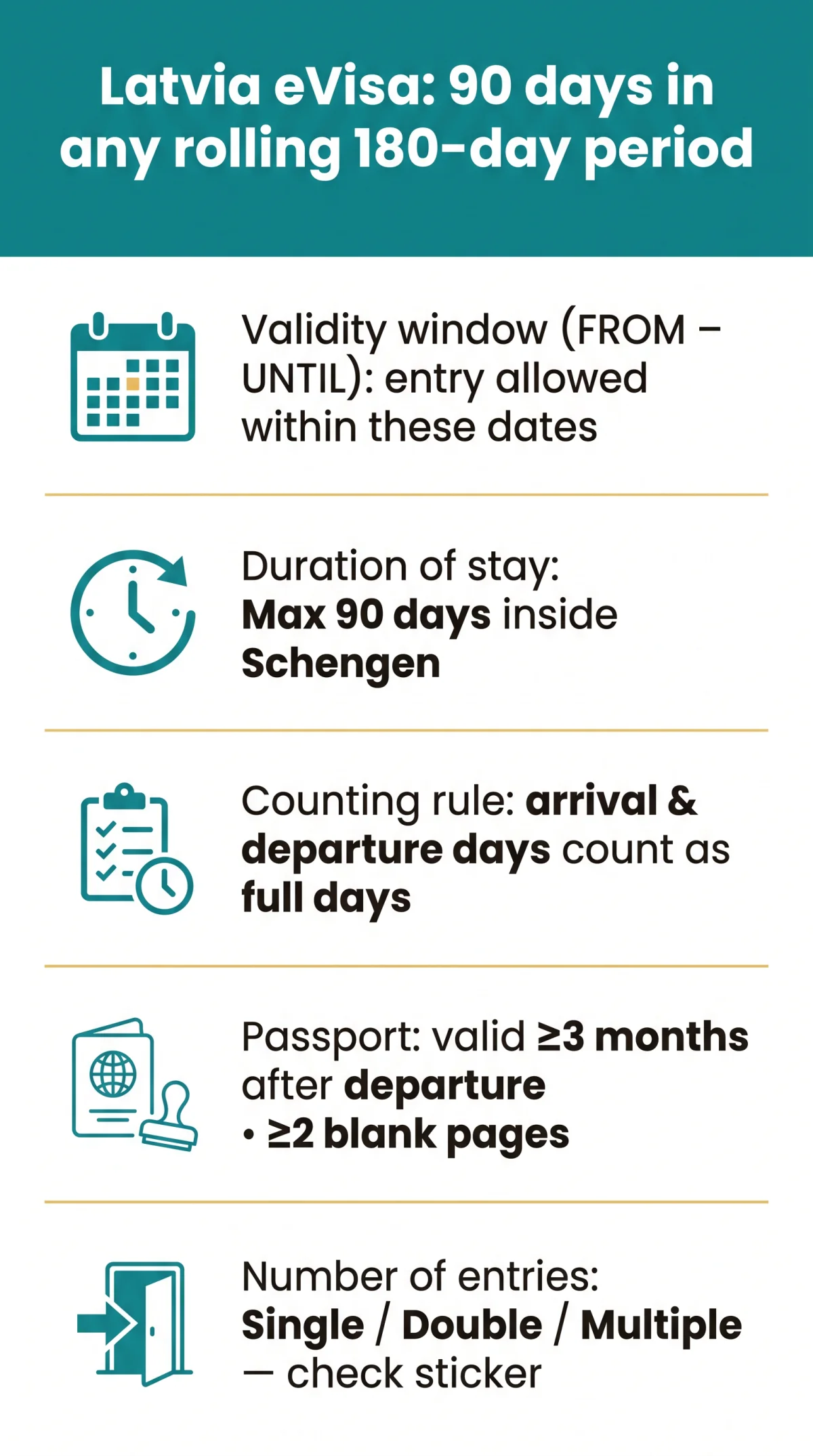
With a Latvia eVisa, you may stay in the Schengen Area for up to 90 days within any rolling 180-day period. The visa’s validity window (FROM-UNTIL dates) defines when you may enter, while the “Duration of Stay” field sets the maximum number of days you may remain. Every Schengen country counts toward your 90-day budget.
Last updated: 10 September 2026.
What Is the Schengen 90/180-Day Rule for a Latvia eVisa?
The Schengen 90/180-day rule is governed by EU Visa Code Article 6(1) and Schengen Borders Code Regulation (EU) 2016/399; Latvia, a full Schengen member, applies it without exception to every short-stay visitor. The regulation caps your physical presence at 90 days within any rolling 180-day period across all 27 Schengen member states.
Latvia eVisa validity counts every day you are physically present in the Schengen Area, regardless of purpose: tourism, business, or transit. The 180-day window is rolling: it shifts forward each day, never resetting on a fixed calendar date.
Latvia eVisa Validity vs Duration of Stay on Your Visa Sticker
The FROM and UNTIL dates on a Latvia eVisa define the entry window; the DURATION OF STAY field (typically 90 days) sets the maximum days you may remain inside Schengen. Per EU Visa Code Article 6(1), the two limits are independent: the UNTIL date never extends the stay allowance. The NUMBER OF ENTRIES field determines whether you may enter once, twice, or multiple times within that validity window.
| Field on Visa Sticker | What It Means | Common Misunderstanding |
|---|---|---|
| FROM / UNTIL | Earliest and latest dates you may enter the Schengen Area | Confused with permitted stay length |
| DURATION OF STAY | Maximum days you may remain inside Schengen (typically 90) | Assumed to equal the validity window length |
| NUMBER OF ENTRIES | Single / Double / Multiple permitted entries | Overlooked: single-entry visa is voided upon first exit |
For example, a Latvia eVisa valid FROM 01/03/2026 UNTIL 29/08/2026 with DURATION OF STAY: 90 days lets you enter anytime in that window but stay a maximum of 90 days, not the full six-month validity period. Latvia eVisa validity does not extend beyond the UNTIL date even if unused days remain.
Passport Requirements for a Latvia eVisa
Your passport must be valid for at least 3 months beyond the planned departure date from the Schengen Area, contain a minimum of 2 blank pages, and remain valid for the entire validity window of the eVisa. For a full breakdown of document and photo standards, see our Latvia visa photo and passport requirements guide.
Single-Entry vs Multiple-Entry Latvia eVisa Differences
A single-entry Latvia eVisa is voided upon first exit from the Schengen Area, whereas a multiple-entry Latvia eVisa permits unlimited re-entries within the validity window: both subject to the same 90/180-day cap. A double-entry visa sits between these extremes, permitting exactly two entries.
The 90/180-day limit is cumulative across all entries on a multiple-entry visa: not 90 days per entry. Travellers have been denied boarding in Riga after assuming a single-entry visa permitted re-entry following a day trip to Tallinn. Always verify NUMBER OF ENTRIES on your Latvia eVisa sticker before exiting the Schengen Area.
| Scenario | Single-Entry eVisa | Multiple-Entry eVisa |
|---|---|---|
| Enter Latvia, leave, re-enter Latvia (same 180-day window) | ❌ Visa voided at first exit | ✅ Permitted if within 90/180 limit |
| Visit Latvia, then Estonia, then return to Latvia | ❌ Cannot re-enter Schengen | ✅ Allowed if within 90/180 budget |
| One continuous 60-day stay in Latvia | ✅ Valid (within DURATION OF STAY) | ✅ Valid (within DURATION OF STAY) |
How to Calculate the Rolling 180-Day Window
Every Latvia eVisa holder must understand how the rolling 180-day window is calculated. On any given day, count every day spent in the Schengen Area over the preceding 180 calendar days; the total must not exceed 90. Both your day of arrival and day of departure count as full days.

Choose your reference day
Pick any calendar day as your reference point and look back 180 days from it.
Count Schengen days
Count every day you were physically present in any of the 27 Schengen member states within that window.
Include entry & exit dates
Add both your entry date and your exit date as full days, not half days.
Check against the 90-day limit
If the total reaches 90, you must leave the Schengen Area and wait until enough days fall outside the 180-day window before re-entering.
180-day window on 30 June 2026:
|--------- 180 days ---------|
03 Jan                     30 Jun
   [== 16 days ==]               March trip
          [====== 30 days ======]  June trip
   Total days in window: 46 / 90
Worked example for a Latvia eVisa holder: enter Latvia on 1 March 2026, depart 30 April 2026: 60 days. On 1 July 2026, the window reaches back to 3 January 2026; your 60 days still count, leaving 30 remaining.
Does Time Spent in Other Schengen Countries Count?
Yes. Days spent in any of the 27 Schengen member states reduce the same shared 90-day budget. Time in non-Schengen countries such as the United Kingdom or Ireland does not count. A trip from Riga to Tallinn to Helsinki and back to Riga pools all days together against your Latvia eVisa allowance.
Tracking Your Stay and the 2026 Entry/Exit System (EES)
The EU Short-Stay Calculator tests itineraries against the 90/180 limit, while the Entry/Exit System (EES) rolling out in 2026 automates day-tracking via biometric gates at Latvian border control points.
Using the EU Short-Stay Calculator
The European Commission’s free Short-Stay Calculator computes remaining Schengen days by applying the rolling 180-day window to each trip’s entry and exit dates. Enter each trip’s dates to see your remaining balance under EU Visa Code Article 6(1).
What Changes with EES in 2026?
During 2026, EES is expected to deploy at Latvian border crossings, replacing passport stamps with biometric registration (fingerprints + facial image) and automatically computing each traveller’s 90/180-day balance. EES does not change the 90/180-day rule itself; only the recording method shifts from stamps to electronic gates. Latvia eVisa holders should still self-track using the EU calculator as a backup.
What Happens If You Overstay Your Schengen Visa in Latvia?
Overstaying a Latvia eVisa by even 1 day triggers enforcement by the PMLP (Office of Citizenship and Migration Affairs). Consequences include an administrative fine under Latvian Immigration Law (Likums “Par ieceļošanas kārtību, uzturēšanos un izceļošanu”), a potential 1-5 year Schengen entry ban under Schengen Borders Code Article 29, and a Schengen Information System (SIS) alert record.
There is no grace period. Overstays are detected at border exit or on next Schengen entry by comparing stamps or EES data against the 90/180 calculation. Some travellers discover an overstay only when denied boarding for a return flight from Riga. For more on avoiding this situation, see our guide on Latvia visa delays and how to avoid overstaying.
In-country extensions are possible only in exceptional circumstances: force majeure or humanitarian reasons under PMLP authority. Routine tourist extensions are not granted. For penalty details, consult the Latvian Office of Citizenship and Migration Affairs (PMLP). Practical tip: depart 1-2 days before the 90-day limit to account for the arrival/departure day counting rule.
Does a Latvian National Visa (Type D) Affect Your 90-Day Schengen Allowance?
Time spent in Latvia on a Type D national visa does not count toward the 90-day Schengen short-stay allowance in other Member States. For example, 60 days in Latvia on a Type D visa still leaves you up to 90 days to visit other Schengen countries under a separate Type C eVisa.
You cannot use a Type C short-stay eVisa while inside Latvia on a Type D; the Type D governs your residency. Type D holders must register with PMLP within prescribed deadlines, which affects Schengen travel privileges.
Concrete scenario: if you hold a Latvian Type D visa valid 1 January to 31 December 2026 and spend 60 days in Latvia (excluded from the 90/180 count), you can still visit France for up to 90 days in any 180-day period under a separate Type C Latvia eVisa or Schengen visa.
FAQ
How many days can I stay in Latvia with a Schengen eVisa?
Up to 90 days within any rolling 180-day period across all 27 Schengen member states. The limit applies cumulatively to all Schengen countries combined, not 90 days per country. Both arrival and departure days count as full days.
How is the 90/180-day rule calculated for a Latvia eVisa?
On any given day, count every day spent in the Schengen Area over the preceding 180 calendar days. The total must not exceed 90. Both your day of arrival and day of departure count as full days.
What is the difference between a single-entry and multiple-entry Latvia eVisa?
A single-entry eVisa is voided the moment you exit the Schengen Area, even if unused days remain. A multiple-entry eVisa permits unlimited re-entries within the validity window, but the 90/180-day limit is cumulative across all entries, not 90 days per entry.
Does time spent in other Schengen countries count towards my Latvia eVisa stay?
Yes. Days in any of the 27 Schengen member states reduce the same shared 90-day budget. Time in non-Schengen countries such as the United Kingdom or Ireland does not count.
Can I stay 90 days in Latvia with a multiple-entry eVisa?
Yes, you may stay up to 90 days within any rolling 180-day period. The cap applies cumulatively across all trips and all Schengen countries. You cannot reset the counter by leaving and re-entering.
Is there a free Schengen visa calculator I can use?
Yes. The European Commission provides a free online Short-Stay Calculator at ec.europa.eu/home-affairs/content/visa-calculator_en. Enter each trip’s entry and exit dates to compute your remaining Schengen days.
What happens if I overstay my Latvia eVisa by a few days?
Overstaying by even one day can trigger an administrative fine under Latvian Immigration Law (Likums “Par ieceļošanas kārtību, uzturēšanos un izceļošanu”), a 1 to 5 year Schengen entry ban under Borders Code Article 29, and a Schengen Information System (SIS) alert. There is no grace period.
Do I need a Latvia eVisa as a UK citizen in 2026?
As of 2026, UK nationals do not require a visa for short Schengen stays (up to 90 days) under the visa-free regime. ETIAS (Regulation (EU) 2018/1240), when launched, will cost EUR 20 (exemptions for under 18 or over 70) with over 95% of applications auto-approved within minutes. Check gov.uk before travel.
How does the new Entry/Exit System (EES) affect my Latvia eVisa stay in 2026?
EES replaces manual passport stamps with biometric registration (fingerprints + facial image) at automated gates and automatically computes your 90/180-day balance. EES deployment at Latvian border crossings is expected during 2026. EES does not change the 90/180-day rule itself; only the recording method changes.
Does a Latvian Type D national visa reduce my 90-day Schengen allowance?
No. Time in Latvia on a Type D national visa does not count toward the 90-day Schengen short-stay allowance. You can still visit other Schengen countries for up to 90 days in any 180-day period under a separate Type C visa.